
About Magnesium Sulphate
It is used in different areas, such as industrial applications and household uses. It is important to note the difference between anhydrous magnesium sulphate and its hydrated variants, as their properties.

Physical and Chemical Properties
The density of magnesium sulphate anhydrous is 2.66 g/cm3, magnesium sulphate heptahydrate is 1.68 g/cm3, and magnesium sulphate monohydrate is 2.445 g/cm3.
The melting point depends on its hydrated forms; anhydrous is 1124°C, heptahydrate is 150°C, and monohydrate is 200°C.
Structure of Magnesium Sulphate
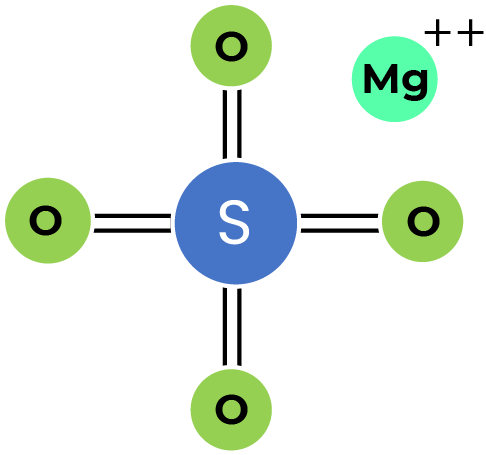
Magnesium Sulphate – Specifications:
Magnesium sulphate is a critical compound used across pharmaceutical, chemical, and industrial domains. Below are its technical characteristics and behavior under various conditions.
Solubility
- Heptahydrate: 71 g/100 mL at 20 °C
Anhydrous
- 26.9 g/100 mL at 0 °C
- 35.1 g/100 mL at 20 °C
- 50.2 g/100 mL at 100 °C
Appearance & Odor
Appears as a white crystalline solid or transparent/colorless needles in heptahydrate form. Odorless in all forms.
Hygroscopic Nature
The anhydrous form absorbs moisture quickly from air. Hydrated forms may gain or lose water depending on ambient humidity and temperature.
Production Process
Magnesium sulphate is typically produced in industrial applications by
reacting magnesium oxide (MgO) with sulphuric acid (H2SO4).
MgO + H2SO4 → MgSO4 + H2O
Magnesium Sulphate uses:
Textile Industry
Magnesium sulphate anhydrous is used in the textile sector and as industrial salt. It acts as a colorant during the treatment and refinement of materials. When it is added to a dye solution, salt helps the dye completely absorb into the fabric. The presence of magnesium sulphate anhydrous is essential for creating non-iron textile products.
Food Industry
Magnesium sulphate epsom salt, is used in flour, cheese, and as a nutrient. As a food additive, it helps improve the texture of canned vegetables. In beer brewing, magnesium sulphate is employed as a brewing salt. It acts as a coagulant in the process of producing tofu. It can serve as a nutrient in salt substitutes, diet carbonated soft drinks, sports beverages, and fortified water drinks.
Pulp & Paper Industry
Magnesium sulphate anhydrous in the pulp-and-paper sector, MgSO4 is an element that preserves and enhances paper’s physical and mechanical characteristics when dulling agent. especially those containing chlorine. are employed. Also, it’s used in the manufacture of fire-resistant paper products. It acts as a stabilizer in the production of paper.
Cleaning and Detergents
Magnesium sulphate anhydrous is included in heavy-duty detergents, provides a gentle effect on fibers, and has a neutral impact on wastewater. It is utilized in liquid soaps, cleansers, and rinse products to manage thickness. Industrial salt is the main component used in the manufacturing of detergents. Epsom salt is used in laundry, it brightens up white and light color clothes. It is also used to clean carpets and sanitize shoes. The Epsom salt is mixed with other ingredients and utilized as a cleaning agent.
Construction Industry
Magnesium sulphate epsom salt is among the most efficient and commonly utilized additives for anhydrite flooring and lightweight panels, as well as for specific varieties of dry wall, ceiling board, and in the materials of fireproofing materials.